




Your Knees Aren't the Problem. Your Ankles Are.

Every rep you do standing up starts at the floor. The ground sends force into your body whether you ask it to or not — landing, squatting, walking, lunging — and the first major joint that has to receive and absorb that force is your ankle. Before your knee gets a vote, before your hips do anything, the ankle is already deciding how the rest of the chain is going to move.
That makes the ankle a foundation. And like any foundation, you don't notice it until it's the problem — usually somewhere else.
The job each joint is supposed to do
Think of your body as a stack of alternating jobs. Some joints are built to be mobile — they're supposed to move through big ranges. Others are built to be stable — their job is to stay put and transfer force cleanly. Your ankle is a mobility joint. Your knee, sitting right above it, is a stability joint. It's a simple, beautiful hinge that wants to track straight over your foot and not much else.
Here's the catch: when a joint that's supposed to move stops moving, the body doesn't just quit. It finds the range somewhere else — and it usually steals it from the neighbor. A stiff ankle can't bend forward enough to let your shin travel over your foot in a deep squat, so that missing motion has to come from somewhere. The knee, which only wanted to be a clean hinge, gets drafted into doing a mobility job it was never designed for.
How a stiff ankle becomes a sore knee
Watch someone with tight ankles try to squat. One of two things happens. Either the heels lift off the floor — the body bailing on the ankle entirely — or, more often, the knees cave inward and the feet roll flat to scrounge up range the ankle won't give. That inward collapse is the knee twisting to find motion it doesn't have. Do it under a bar, or for a few thousand steps a day, and the knee starts paying a tax it didn't sign up for.
This is why so much "knee pain" isn't really a knee story. The knee is just the loudest joint in the room. The quiet one two inches below it — the ankle that won't bend — is the one writing the checks.
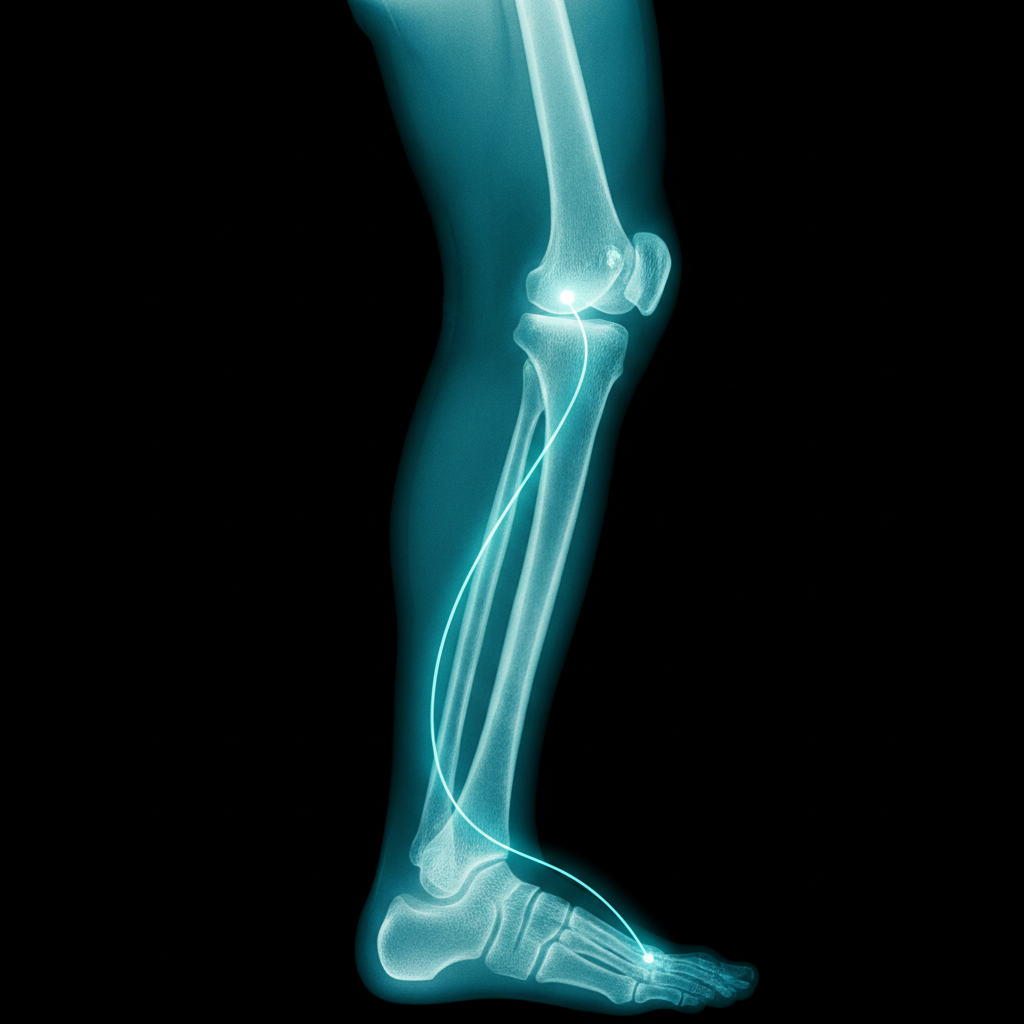
Check yours in thirty seconds
Kneel a few inches from a wall, one foot forward, and drive your front knee toward the wall without letting your heel pop up. If your knee can touch the wall with your heel flat — and you can do it on both sides — you've got the ankle range a clean squat needs. If the heel lifts, or one side is noticeably worse, you've found a foundation problem. Most people have more on one side than the other, and that asymmetry is worth chasing down before you load it.
Heels up is a teacher, not a home
If your ankles are stiff today, elevating your heels — a small wedge, a pair of lifting shoes, a couple of plates — is one of the best tools you've got. It artificially gives the shin somewhere to go, so you can finally feel what it's like to break parallel and sit into a deep squat with your chest tall and your spine stacked. It lets you practice the position instead of fighting for it. That's valuable. Owning depth, even assisted, teaches your nervous system what "down there" is supposed to feel like.
But understand what it is: a bridge, not a destination. The heel lift is borrowing the range your ankle can't yet produce. The long game is to earn that depth — to squat below parallel with your heels flat, your feet stable, and your knees tracking clean, no wedge required. Keep using the elevation to train the pattern while you open the ankle in parallel. Then, over weeks, lower the heel and let the real range take over.
Where the kettlebell earns its keep
This is exactly the problem the goblet squat was built for. Holding a kettlebell at your chest acts as a counterweight — it lets you sit back and down into the bottom without tipping over, so you can actually live in that deep position and groove it. Stiff today? Run it heels-elevated and let the load and the counterbalance teach the depth. As the ankle opens up, take the elevation away and keep the same honest position on flat ground.
Pair it with a little daily ankle work — that knee-to-wall drive done as a slow, loaded mobilization (a kettlebell on the thigh adds a gentle push), plus some time on the calves — and you give the foundation a reason to change. Mobilize the ankle, then immediately squat to depth so the new range gets used. Range you don't use, you lose.
Build from the ground up. Free the ankle, protect the knee, and the deep squat stops being something you fight and becomes something you own.
Every SoCal Kettlebellz bell is built to live in your hands at the bottom of a goblet squat — the counterbalance that lets you train depth with integrity. Find your bell →